Bikram Yoga for Desk Workers: Fixing Posture, Joint Pain and Spinal Stiffness With Heat
The modern Singapore office worker spends an average of nine to eleven hours per day seated. Factor in commuting time, meals at desks, and evening screen time, and the cumulative hours of spinal compression, hip flexor shortening, and thoracic rounding become extraordinary. The musculoskeletal consequences of this lifestyle are not merely discomfort. They include structural postural changes, chronic joint inflammation, nerve compression, and accelerated spinal disc degeneration that, left unaddressed, can significantly impair quality of life well before retirement age.
bikram yoga offers a uniquely effective intervention for desk-related postural dysfunction because it addresses the problem on multiple levels simultaneously: it uses therapeutic heat to prepare tight connective tissue for safe deep stretching, it employs a sequence specifically designed to decompress and realign the spine, and it builds the muscular support structures that prevent postural problems from recurring.
What Prolonged Sitting Does to the Spine and Joints
To understand why Bikram Hot90 is so effective for desk workers, it helps to understand precisely what hours of sitting do to the body’s structural systems.
Spinal compression is the most immediate consequence. When seated, particularly in the forward-leaning posture that most people adopt at a computer, the lumbar spine loses its natural lordotic curve and becomes kyphotic. This increases intradiscal pressure in the lower back significantly compared to standing. Over years, this contributes to disc dehydration, reduced disc height, and eventually disc herniation in susceptible individuals.
Hip flexor contracture is another significant consequence. The iliopsoas muscle group, which connects the lumbar spine to the femur, remains in a shortened position during prolonged sitting. Over time, it loses its resting length and begins to pull the lumbar spine into an anterior tilt when standing, creating or exacerbating lower back pain and contributing to poor standing and walking mechanics.
Thoracic kyphosis develops as the upper back rounds to accommodate forward head posture at screens. This compresses the anterior thoracic vertebrae, reduces lung capacity through restricted chest expansion, and creates chronic tension in the posterior neck and upper trapezius muscles that many desk workers know as their persistent shoulder and neck stiffness.
Joint stiffness in the hips, knees, and ankles results from reduced circulation and movement through these structures during prolonged static postures. Synovial fluid, which lubricates joints, is circulated through movement. Sedentary behaviour reduces synovial circulation, leading to progressive joint stiffness and reduced range of motion.
Why Heat Is a Critical Component for Desk Workers
Most stretching and yoga modalities address the muscular components of postural dysfunction reasonably well. Where Bikram Hot90 has a distinct advantage for desk workers is in its use of therapeutic heat, which affects not just muscles but the connective tissue structures that chronic desk posture affects most deeply.
Fascia, the connective tissue web that envelops all muscles and organs, becomes less pliable with both age and sustained static posture. At normal body temperature, fascia is relatively resistant to elongation. At elevated temperatures, its viscosity decreases and it becomes significantly more responsive to stretch. This means that the degree of fascial release achievable in a heated Bikram session is substantially greater than what can be achieved in a room-temperature environment with equivalent effort.
For desk workers with chronic thoracic tightness, hip flexor contracture, and lumbar stiffness, this matters enormously. Postures that might produce mild sensation in a cool environment create genuine therapeutic depth in the heated room. The connective tissue surrounding chronically compressed spinal segments softens and responds to the decompression that the postures create, producing relief that many practitioners describe as feeling as though something has genuinely unlocked in their spine.
Postures in the Bikram Sequence That Target Desk-Related Dysfunction
Several postures in the 26-posture sequence are particularly relevant for the specific patterns of dysfunction that desk work creates.
Half Moon Pose with lateral flexion creates lateral spinal decompression, opening the spaces between vertebrae that prolonged sitting compresses. The backbend component directly counters the forward rounding that desk posture promotes, stretching the anterior thoracic fascia and re-establishing thoracic extension mobility.
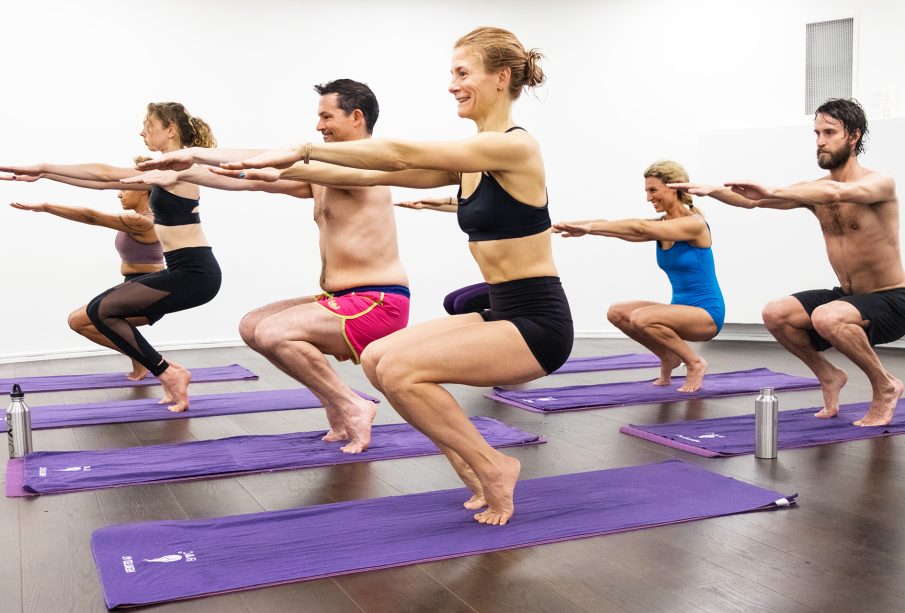
Awkward Pose rebuilds quadriceps and gluteal strength in a way that directly supports improved sitting and standing mechanics. Weak glutes are a common finding in desk workers and contribute significantly to poor lumbopelvic rhythm and lower back strain.
Eagle Pose creates traction through the hip joints and decompresses the sacroiliac region. Many desk workers carry chronic sacroiliac tension that contributes to their lower back discomfort, and this posture provides targeted relief while simultaneously improving hip joint mobility.
Standing Head to Knee and Standing Bow challenge single-leg balance and hip stability, rebuilding the proprioceptive and stabilising functions that atrophy during extended sitting. Improved hip stability reduces the compensatory lumbar strain that unstable hips create.
Camel Pose is one of the most therapeutically significant postures for desk workers. A full thoracic and lumbar backbend, it directly reverses the flexion pattern of desk posture. Performed in the heated room, it creates profound anterior thoracic opening, stretches the iliopsoas bilaterally, and decompresses the posterior spinal structures. Many practitioners experience immediate relief from upper and lower back tension following this posture.
Rabbit Pose provides counter-traction to Camel and creates gentle posterior spinal elongation and decompression, particularly in the cervical and thoracic regions where forward head posture from screen use creates chronic compression.
Rebuilding Muscular Support for Long-Term Postural Change
Stretching and decompression are necessary but not sufficient for lasting postural change. The spine and joints need adequate muscular support to maintain improved alignment outside the studio. The Bikram sequence addresses this through its standing series, which builds functional strength in the posterior chain, including the spinal erectors, glutes, and hamstrings, as well as core stability through the sustained abdominal engagement required in virtually every posture.
Practitioners who complete several weeks of regular Bikram practice typically report not just reduced pain during class and immediately after, but a gradual improvement in how they sit and stand throughout their working day. This reflects genuine neuromuscular re-education. The body has been repeatedly trained in better movement patterns and has begun to adopt them as its default.
What to Expect in the First Month as a Desk Worker
The first few sessions will likely reveal the full extent of restrictions that have developed. Many desk workers are surprised by how limited their spinal extension is, how tight their hip flexors feel, and how challenging balance postures are when the stabilising muscles have been largely inactive. This is important information, not discouragement.
By the third to fourth week, the combination of regular heat-assisted stretching and progressive strength building typically produces noticeable changes. Morning stiffness that previously lasted an hour may resolve within minutes. The chronic dull ache in the lower back that desk workers accept as normal begins to quiet. Neck rotation improves. Sitting at a desk becomes more comfortable because the body now has both the flexibility and the strength to maintain better positioning for longer.
For Singapore desk workers looking to address the physical cost of sedentary professional life, Yoga Edition offers a structured, evidence-informed environment to begin this restoration process, with instructors who understand the specific needs and limitations that office-based practitioners bring to the mat.
FAQ
Q: I have a herniated disc. Is Bikram yoga safe for me?
A: A herniated disc requires medical clearance before beginning Bikram practice. Once cleared, many practitioners with disc issues find significant relief through the decompressive postures and heat. However, certain postures may need modification, particularly deep forward folds, and an experienced instructor should be made aware of your condition before your first class.
Q: How quickly can I expect relief from lower back pain with regular practice?
A: Most practitioners with desk-related lower back pain report noticeable improvement within two to four weeks of attending three or more sessions per week. Significant structural improvement in spinal mobility typically takes six to twelve weeks of consistent practice.
Q: Will Bikram yoga help with the pins and needles I get in my hands from desk work?
A: Pins and needles in the hands from desk work are often related to thoracic outlet compression or cervical nerve impingement, both of which are addressed by postures in the Bikram sequence that open the thoracic region and decompress the cervical spine. Many practitioners report reduction in these symptoms, but persistent neurological symptoms should always be assessed by a physiotherapist or doctor.
Q: Is it necessary to do Bikram yoga every day for desk-related posture issues?
A: Daily practice accelerates initial results, but three to four sessions per week is sufficient for meaningful and sustained postural improvement. Consistency over time matters more than frequency in any single week.
Q: I find it hard to breathe in the heated room. Is this normal for office workers who are not very fit?
A: Yes, it is very common in the early sessions. The heat places additional demand on the cardiovascular system, and people who spend most of their day sedentary typically have reduced cardiovascular efficiency. This improves rapidly with regular attendance. The key is to breathe continuously and take Child’s Pose whenever needed rather than pushing through distress.